








A new school year brings excitement, new routines, and plenty of expenses. Parents may be shopping for supplies, completing enrollment forms, paying school fees, helping a teenager find a job, or preparing a student for college.
Unfortunately, scammers know families are busy. They may impersonate schools, employers, scholarship providers, retailers, and other trusted organizations to persuade you or your child to share personal information or send money.
Learning common warning signs and taking the time to verify unexpected requests can help you avoid many common back-to-school scams.
Table of Contents
- Scholarship and Financial Aid Scams
- Fake Student Job Offers
- Phishing Messages That Look Like School Communications
- Fake Back-To-School Shopping Deals
- Child Identity Theft
- Off-Campus Housing Scams
- Create a Family Scam Check Routine
- What to Do If Your Family Encounters a Scam
- Stay Alert Throughout the School Year
Scholarship and Financial Aid Scams
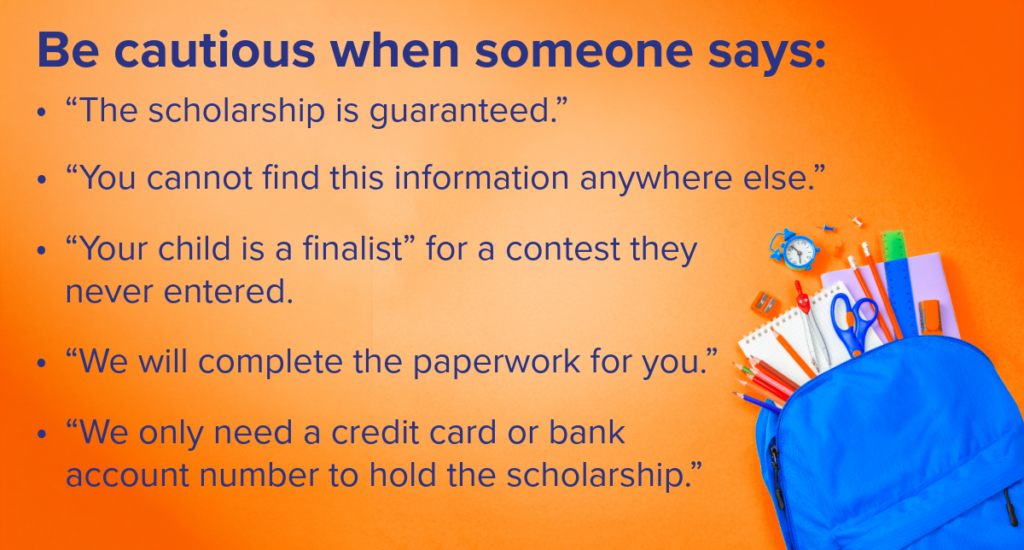
With the rising cost of college, scholarships and financial aid can be especially appealing. Scammers take advantage of that by promising access to guaranteed scholarships, grants, or additional financial aid.
They may claim your child has been selected as a scholarship finalist, even though your child never applied. Others may ask for an application fee, processing fee, bank account number, or credit card information before releasing the supposed award.
The Federal Trade Commission advises families never to pay to apply for a scholarship. Legitimate scholarship providers do not guarantee that a student will receive an award in exchange for an upfront payment. [1]
Families should also protect their StudentAid.gov account information. The U.S. Department of Education and its federal loan servicers will never ask for your StudentAid.gov username and password. [2]
Complete the FAFSA through the official StudentAid.gov website, and verify scholarship opportunities through the student’s school counselor, college financial-aid office, or the scholarship provider’s official website.
Fake Student Job Offers
A part-time job can help a high school or college student earn extra money and build experience. However, an unexpected job offer may be designed to steal money or personal information.
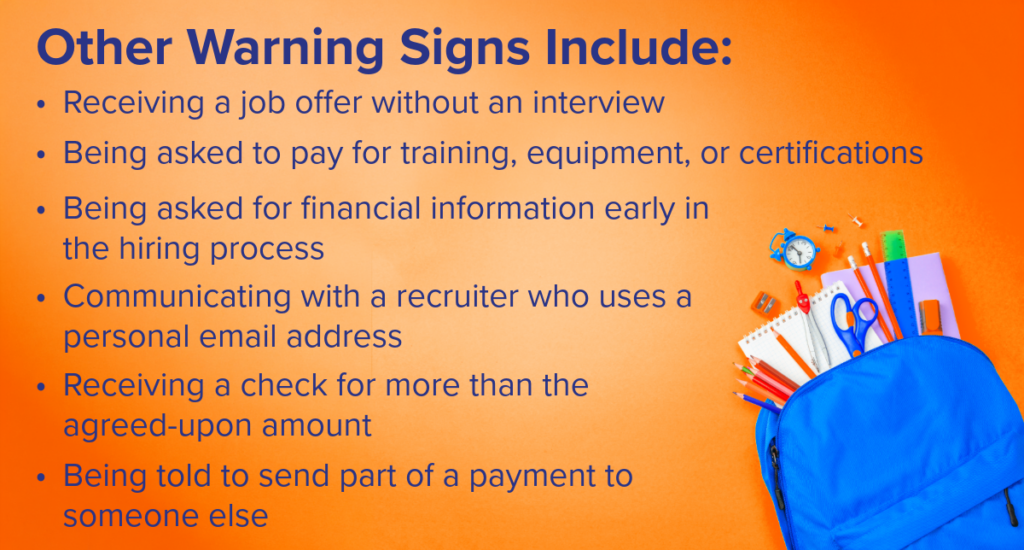
The FTC warns that scammers may advertise fake personal assistant, remote-work, or entry-level positions on job boards and social media. They may also send emails that appear to come from a professor, recruiter, or college office. [3]
In one common version of the scam, the supposed employer sends the student a check and asks them to deposit it. The student is then instructed to use some of the money to purchase equipment, buy gift cards, or send money to another person. The check later turns out to be fraudulent, and the student may be responsible for any money already spent or transferred.
Encourage your child to verify opportunities directly with the employer or school office. They should use contact information from the organization’s official website, not the telephone number or email address provided in the unexpected message.
A legitimate employer should pay your child. Your child should not have to send money to the employer or pay to receive a job.
Phishing Messages That Look Like School Communications
During the school year, parents may receive frequent emails and text messages about registration, schedules, activities, payments, transportation, and school accounts. A fraudulent message can easily get lost among legitimate communications.
Phishing messages may appear to come from a school, teacher, college office, educational service, or technology provider. The message might say that you need to verify an account, pay an overdue fee, update information, or click a link to avoid losing access.
The U.S. Department of Education advises parents and students not to reply to unexpected phishing requests for money or information. [4] The FTC also recommends avoiding links and attachments in unexpected messages and contacting the organization through a telephone number or website you already know is legitimate. [5]
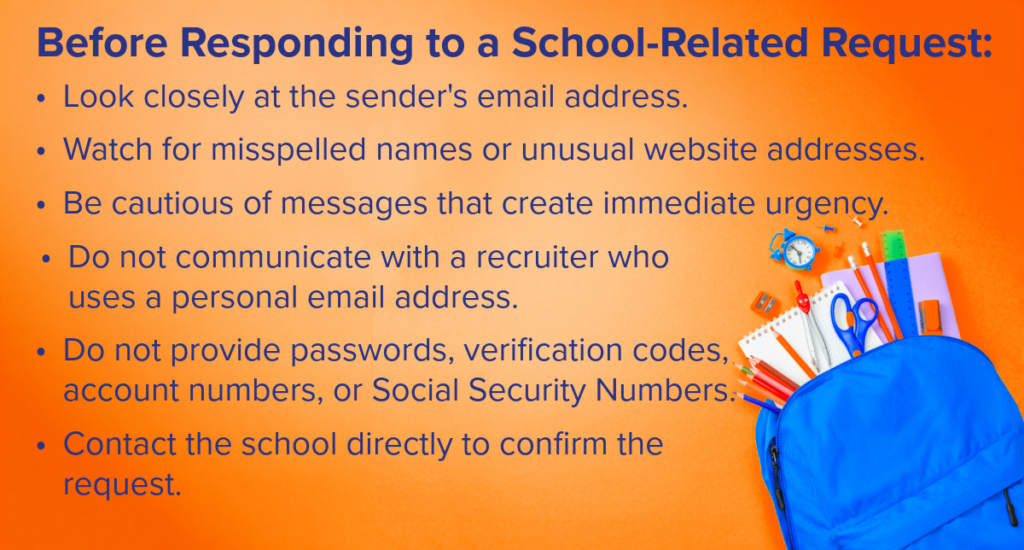
A message can include a school logo, staff member’s name, or information about your child and still be fraudulent. Independently verifying the request is safer than replying directly.
Fake Back-to-School Shopping Deals
School supplies, clothing, laptops, dorm essentials, and other back-to-school purchases can add up quickly. An advertisement offering a popular product at an unusually low price may be tempting, especially when it appears for only a limited time.
Scammers may create fraudulent websites, imitate recognizable retailers, or place deceptive advertisements on social media. The product may never arrive, may be counterfeit, or may differ significantly from what was advertised.
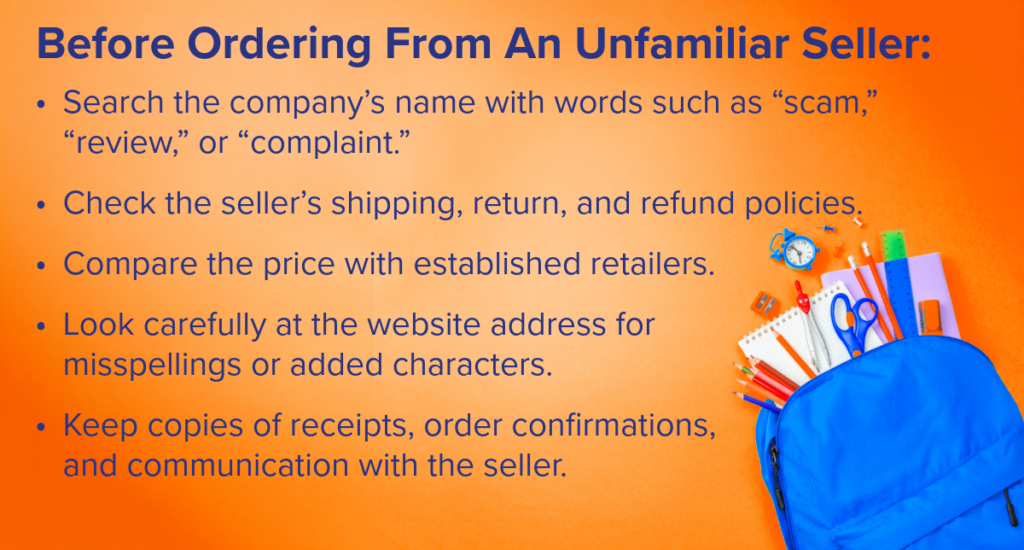
The FTC recommends paying by credit card when possible because credit cards generally provide additional protections and may allow you to dispute a charge when merchandise does not arrive or is not what you ordered. [6]
Avoid sellers who insist that you pay by gift card, wire transfer, cryptocurrency, or a specific payment app. These payment methods can make it difficult to recover your money.
Child Identity Theft
Children can become victims of identity theft even though they are too young to apply for credit themselves.
A thief may use a child’s name, Social Security number, address, or date of birth to open a bank or credit card account, apply for a loan, establish utility service, receive benefits, or rent a home. The fraud may go unnoticed for years because parents generally do not expect a young child to have a credit report. [7], [8]
Back-to-school forms provide a good opportunity to review the personal information your family shares. When a school or organization requests your child’s Social Security number, the FTC recommends asking:
- Why is this information needed?
- How will it be protected?
- Can the organization use a different identifier?
- Can you provide only the last four digits?
Keep Social Security cards, medical records, and other sensitive documents in a secure place. Shred documents containing personal information before throwing them away.
Off-Campus Housing Scams
Parents helping a college student find an apartment should also watch for fraudulent rental listings.
Scammers may copy photos and descriptions from a legitimate listing, replace the real property manager’s information with their own, and collect application fees or deposits for a property they do not own. Other scammers may invent a property that is not available or does not exist. [9]
A fraudulent landlord may also request a Social Security number, driver’s license, pay stubs, or other personal information through a fake application.
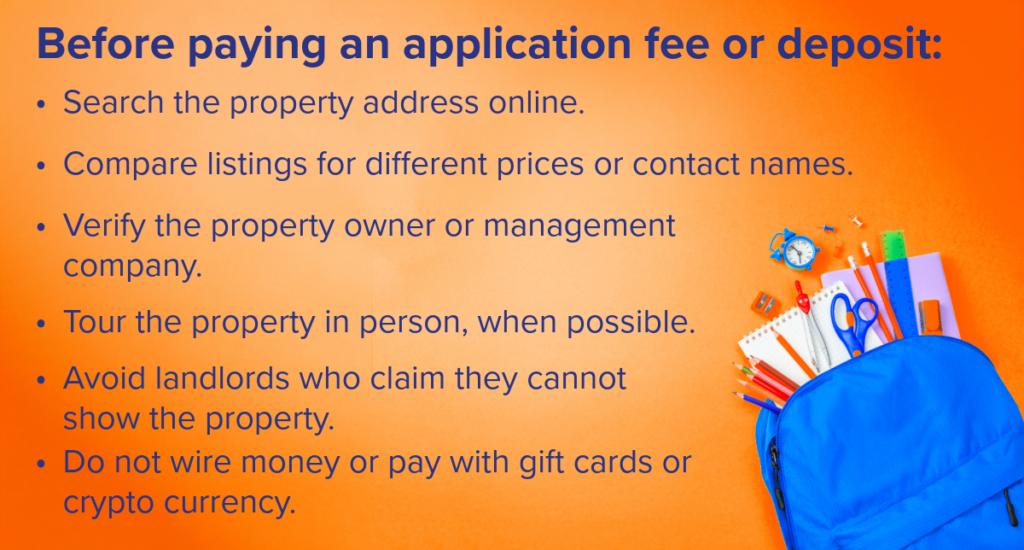
Be especially cautious when someone pressures your family to pay immediately by claiming other renters are waiting.
Create a Family Scam-Check Routine
Scammers often rely on urgency. They want a parent or student to react before talking to someone else or checking whether the request is legitimate.
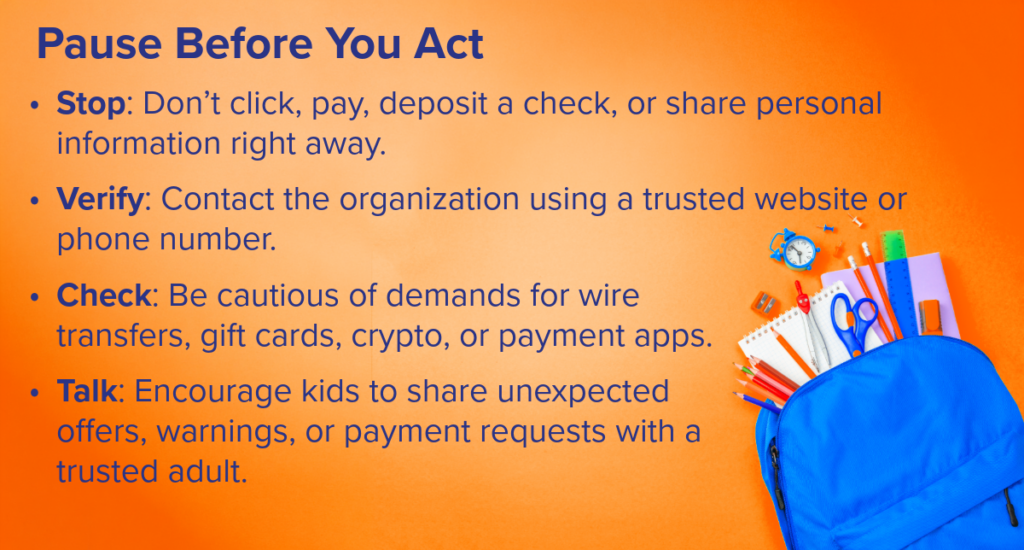
Make it clear that they will not be in trouble for asking questions or admitting that they clicked a suspicious link. A quick conversation may prevent a much larger problem.
What to Do if Your Family Encounters a Scam
Scammers can be convincing, and falling for one does not mean that you or your child were careless. The most important step is to act quickly.
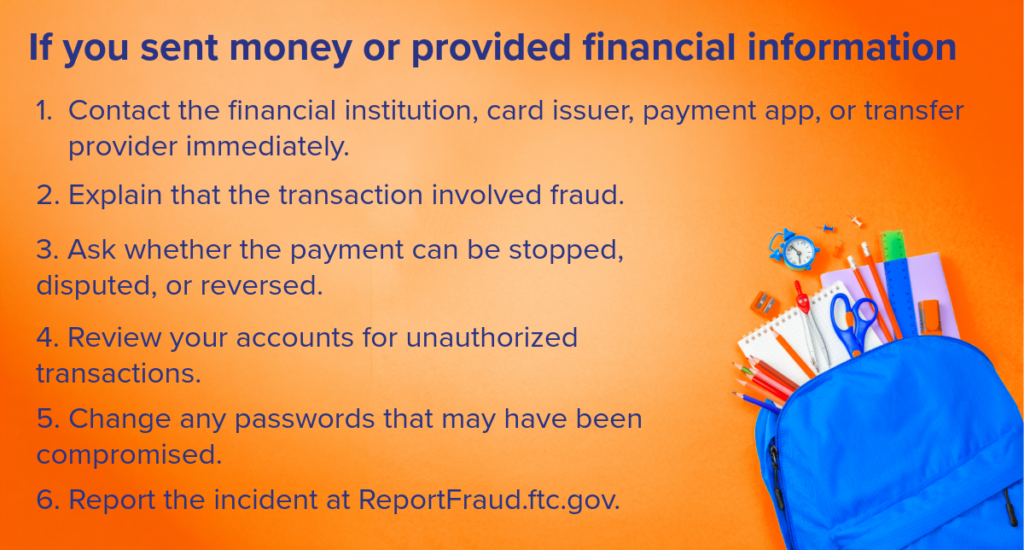
If someone used your child’s personal information, visit IdentityTheft.gov for a personalized recovery plan. Contact the companies where fraudulent accounts were opened and notify each of the three nationwide credit bureaus.
Sun East will never call or text requesting your account details, including Online Banking credentials, one-time passcodes, credit or debit card numbers, PINs, or any other personal information. If you receive a suspicious call or text claiming to be from Sun East, do not respond—instead, contact us immediately at 610-485-2960.
Important Reminder: If you receive an SMS message attempting to verify a card transaction that you did NOT authorize, NEVER reply “Yes.” This could be a fraud attempt.
Your security is our priority—stay vigilant and protect your information!
Stay Alert Throughout the School Year
Back-to-school season can be hectic, but families do not have to live in fear of every email, advertisement, or opportunity.
Take a moment to question unexpected requests, verify information through a trusted source, and talk openly with your children about scams. Slowing down for even a few minutes can help protect your family’s money, personal information, and peace of mind.
Sources
- [1] Federal Trade Commission, “How To Avoid Scholarship and Financial Aid Scams.”
https://consumer.ftc.gov/articles/how-avoid-scholarship-and-financial-aid-scams - [2] Federal Student Aid, U.S. Department of Education, “How To Avoid Student Loan Forgiveness Scams.”
https://studentaid.gov/articles/avoid-student-loan-forgiveness-scams/ - [3] Federal Trade Commission, “College Students: Avoid Scammers While You Job Hunt.”
https://consumer.ftc.gov/consumer-alerts/2025/05/college-students-avoid-scammers-while-you-job-hunt - [4] U.S. Department of Education, Student Privacy Policy Office, “Flyer: Don’t Take the Bait.”
https://studentprivacy.ed.gov/resources/flyer-dont-take-bait - [5] Federal Trade Commission, “Protect Your Personal Information From Hackers and Scammers.”
https://consumer.ftc.gov/articles/protect-your-personal-information-hackers-and-scammers - [6] Federal Trade Commission, “Online Shopping.”
https://consumer.ftc.gov/articles/online-shopping - [7] Federal Trade Commission, “How To Protect Your Child From Identity Theft.”
https://consumer.ftc.gov/articles/how-protect-your-child-identity-theft - [8] Federal Trade Commission, “Back to School: Children’s Privacy.”
https://consumer.ftc.gov/consumer-alerts/2022/08/back-school-childrens-privacy - [9] Federal Trade Commission, “Rental Listing Scams.”
https://consumer.ftc.gov/articles/rental-listing-scams - [10] Federal Trade Commission, “A Way to Spot Scams: How Someone Asks You to Pay.”
https://consumer.ftc.gov/consumer-alerts/2026/07/way-spot-scams-how-someone-asks-you-pay - [11] Federal Trade Commission, “What To Do if You Were Scammed.”
https://consumer.ftc.gov/articles/what-do-if-you-were-scammed