








Side hustles are a common way people bring in extra money; however, without proper planning or business organization skills, many feel side swiped when tax season comes and they owe way more than they anticipated!
Learning a few smart habits now can save you hours later and help you understand the administrative side of running a small business.
In honor of Entrepreneurship Week, we’ll cover six administrative basics that apply to many common side hustles, including freelancing, selling products online, tutoring, rideshare, home services, and content creation.
1. Set Up Your “Business Admin” Foundation
Do these first, even if you stay small:
- Separate your money. Use a dedicated checking account for your side hustle so your income and expenses stay clean and easy to track. Sun East offers dedicated business banking features and products to support business members like you.
- Decide whether you need an EIN. Many sole proprietors can use a Social Security number, but an EIN can make sense if you want to keep your SSN private on forms, open certain accounts, hire help, or form an entity. The IRS issues EINs for free online. [7]
- Confirm registration, tax IDs, and licenses. Requirements depend on your state, local area, and what you sell or do. The Small Business Administration’s launch guide walks through registering your business, getting tax IDs, and applying for licenses and permits. [8]
2. Bookkeeping Basics That Keep You Out of Trouble
The IRS does not require a specific bookkeeping system, but your system must clearly show income and expenses. [1]
A simple approach that works for most side hustles:
- Track every sale and every expense. Log it weekly, not yearly.
- Keep a summary plus proof. Your system should include books (like a ledger or accounting software) and supporting documents (receipts, invoices, bank statements). [3]
- Organize by category. Common categories include supplies, advertising, software, fees, mileage, shipping, and home office (when eligible).
- Save records where you can find them. Use a folder structure by year, then by month, then by category.
3. Gross Income vs Net Income and Why the Difference Matters
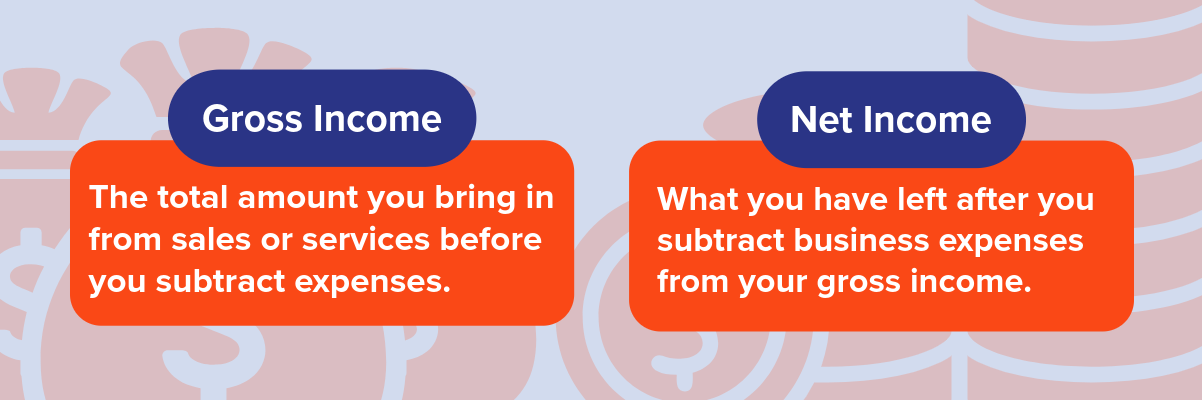
Practical example:
- You earn $8,000 from clients (gross)
- You spend $1,200 on supplies, software, and fees (expenses)
- Your net profit is $6,800 (net)
You need this net number for taxes, budgeting, and goal setting.
4. Tax Prep Essentials for Side Hustles
You Must Report Side Hustle Income
The IRS expects you to report income from gig work even when you do not receive a tax form. [5]
Know the $400 Rule for Self-Employment Filing
If you have net earnings from self-employment of $400 or more, you generally must file a tax return. [5]
Plan for Estimated Taxes
When you earn income without withholding, you may need to pay taxes during the year.
- The IRS explains how estimated taxes work and points to Form 1040-ES for calculations. [6]
- The IRS FAQ lists the typical quarterly due dates (April 15, June 15, Sept. 15, and Jan. 15), with special rules in some cases. [6]
Understand Common Tax Forms You Might See
- 1099-K (payment apps and online marketplaces): The IRS explains what Form 1099-K is and how to use it with your records. [9] Platforms can still issue a 1099-K at lower amounts, so track your own totals and compare them to any forms you receive. [9]
- 1099-NEC (if you pay contractors): If you run your side hustle and pay independent contractors, IRS rules may require Form 1099-NEC. [10]
5. Protect Customer Information and Your Own Data
If your side hustle collects personal information (names, addresses, payment details, or anything sensitive), build safe habits now.
The FTC recommends keeping sensitive data only as long as you have a business reason and creating a records retention policy that covers what you keep, how you secure it, how long you keep it, and how you dispose of it. [11]
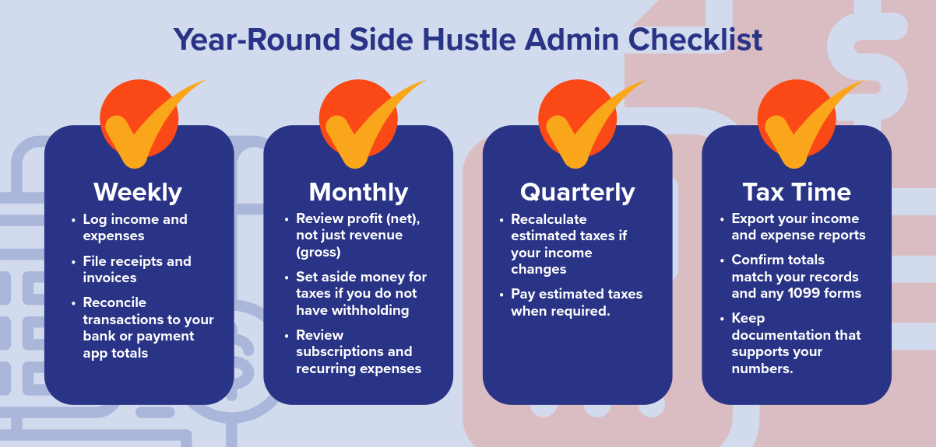
6. Your “Year-Round” Side Hustle Admin Checklist
Here is a checklist you can use built around different time frames. We’ve broken the items down into weekly, monthly, quarterly, and tax time categories.
Do It Right! Set Good Habits Early.
Running a side hustle does not require complicated systems, but it does require consistent habits. When you separate your business money, track income and expenses as you go, and understand the difference between gross income and net profit, you give yourself clearer numbers and fewer surprises at tax time. [1],[3], [4]
As you grow, keep your records organized, protect any customer information you collect, and revisit estimated taxes if your income changes during the year. Those small administrative steps can help you stay compliant, make smarter decisions, and feel more confident about the business you are building. [6],[11]
Sources
- IRS, Recordkeeping
- IRS, Publication 583 (Starting a Business and Keeping Records)
- IRS, What kind of records should I keep?
- IRS, Schedule C (Form 1040)
- IRS, Manage taxes for your gig work
- IRS, Estimated taxes (and related due date guidance)
- IRS, Get an employer identification number
- SBA, Register your business
- IRS, Understanding your Form 1099-K
- IRS, Reporting payments to independent contractors
- FTC, Protecting Personal Information: A Guide for Business
Disclaimer
This article shares general educational information and does not provide tax, legal, or investment advice.
Third party linked websites are not under the control of Sun East Federal Credit Union. We are not responsible for their content. Third party website privacy and security policies may differ from ours. If you choose to engage in a transaction with a third party, please note that we do not represent either you or the third party in that transaction.